Let me be honest with you. Six years ago, my mornings were a disaster. I’d hit snooze four times, stumble to my laptop still half-asleep, and waste the first two hours of my day scrolling through emails and feeling overwhelmed. As the CEO of LifeHack and a father of two boys, I knew something had to change. My chaotic mornings were setting a terrible example for my kids and sabotaging my company’s growth.
Everything shifted when I discovered the neuroscience behind creating a morning routine for productivity and built a systematic approach around it. Within weeks, I was accomplishing more before 9 AM than I used to achieve in an entire day. My energy levels soared. Decision-making became clearer. Even my team noticed the difference—I was showing up as a better leader, more focused and present.
What I’m about to share isn’t just another generic “wake up at 5 AM” productivity hack. This is a research-backed system that’s been refined through years of testing, countless scientific studies, and real-world application. It’s flexible enough to work whether you’re a parent juggling school drop-offs or a founder pulling late nights. The best part? You can start tomorrow morning.
The Neuroscience of Morning Productivity
Your brain isn’t just waking up when you open your eyes—it’s orchestrating a complex symphony of chemicals designed to prime you for peak performance. Think of your circadian rhythm as your body’s internal CEO, and the morning hours are when it’s most prepared to make executive decisions.
When you wake, your body releases a surge of cortisol—the cortisol awakening response (CAR)—which acts like nature’s espresso shot, sharpening your cognitive function and preparing you for the day ahead [1]. This isn’t the chronic stress cortisol that gets bad press; this is your biological rocket fuel, peaking 30-45 minutes after waking.
But here’s the kicker: your brain has a limited budget for decisions. Research shows we make about 35,000 choices daily, and each one depletes our mental reserves—a phenomenon called decision fatigue. It’s like having a smartphone battery that can’t be recharged until tomorrow. Morning decisions happen when your battery is at 100%, which is why CEOs like Tim Cook and successful entrepreneurs tackle their most important work before breakfast.
The real magic happens through consistency. When you repeat morning behaviors for 66 days on average, they become automatic habits stored in your basal ganglia—your brain’s autopilot system [2]. Each consistent morning routine is like compound interest for your productivity. Small 1% improvements in your morning cascade into exponential gains throughout your day, week, and career.
The Pre-Morning: Setting Up Success the Night Before
Your morning productivity actually starts the night before. Think of it like prepping ingredients before cooking – when everything’s ready, you can create something amazing without the stress.
First, let’s talk sleep optimization. Aim for 7-9 hours, but quality beats quantity every time. Set a consistent bedtime (yes, even on weekends), and create a “sleep runway” – dim your lights 90 minutes before bed, swap your phone for a book, and keep your bedroom at 65-68°F. I personally use blue light blocking glasses after 8 PM, and it’s been a game-changer.
The “shutdown ritual” is your secret weapon. About 30 minutes before bed, do a complete brain dump: write tomorrow’s top three priorities, capture any lingering thoughts, and review your calendar. This tells your brain “we’re done for today” and prevents those 2 AM worry sessions.
Finally, set up your environment like you’re doing your future self a favor. Lay out your workout clothes, prep your coffee maker, and clear your workspace. I even queue up my morning meditation app and place my journal next to my bed. When you wake up, everything flows naturally – no decisions, no friction, just execution.
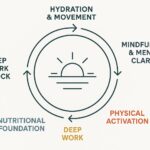
The 5-Phase Morning Routine for Productivity Framework

Phase 1: Hydration & Movement
Here’s the counterintuitive truth: your brain is dehydrated after 7-8 hours without water, and that first glass of water might be more important than your morning coffee. I learned this the hard way after years of stumbling straight to the coffee maker.
Start with 16-24 ounces of room temperature water with a pinch of sea salt and lemon. This jumpstarts your metabolism and helps flush out metabolic waste. Then, before you even think about checking your phone, spend 5 minutes on gentle movement. I’m talking simple stuff—arm circles, neck rolls, maybe a few cat-cow stretches. Nothing Instagram-worthy, just enough to tell your body “hey, we’re awake now.”
The magic happens when you combine hydration with movement. Your lymphatic system doesn’t have a pump like your cardiovascular system, so it relies on physical movement to circulate. Those simple stretches are literally helping your body take out the trash from overnight cellular processes.
Phase 2: Mindfulness & Mental Clarity
Your mind is like a snow globe that’s been shaken all night by dreams and subconscious processing. Before diving into the day’s chaos, you need to let those flakes settle. This isn’t woo-woo stuff—it’s backed by neuroscience.
Start with just 5-10 minutes of breathing or meditation. If sitting still makes you antsy (like it did for me), try box breathing: inhale for 4, hold for 4, exhale for 4, hold for 4. Repeat 4-8 times. Your prefrontal cortex will thank you.
Follow this with 10 minutes of stream-of-consciousness journaling. Don’t overthink it—just dump whatever’s in your head onto paper. I call it “mental decluttering.” You’ll be amazed at what surfaces. Some days it’s grocery lists and anxiety about meetings. Other days, it’s breakthrough solutions to problems you’ve been wrestling with. The key is getting it out of your head so your brain can focus on what matters today.

Phase 3: Physical Activation
Here’s where most productivity gurus lose me—not everyone has 90 minutes for a CrossFit session at 5 AM. Let’s be realistic about what actually works for busy humans.
The minimum effective dose? 10-20 minutes of movement that gets your heart rate up. This could be a brisk walk, jumping jacks, burpees, or my personal favorite: a 15-minute yoga flow. The goal isn’t to exhaust yourself; it’s to flood your brain with BDNF (brain-derived neurotrophic factor), which is basically Miracle-Gro for your neurons.
I rotate between three options depending on my energy: high-intensity intervals when I’m feeling strong, yoga when I need flexibility (physical and mental), or a neighborhood walk when I just need to move. The best exercise is the one you’ll actually do. Pro tip: lay out your workout clothes the night before. Removing friction is half the battle.
Phase 4: Nutritional Foundation
Forget the complicated smoothie recipes with 47 ingredients. Your morning fuel needs to be simple, protein-forward, and blood-sugar friendly. Why? Because that mid-morning crash isn’t just about caffeine—it’s about starting your day with a sugar bomb disguised as a healthy breakfast.
Aim for 25-30 grams of protein within the first hour of waking. My go-tos: Greek yogurt with nuts and berries, scrambled eggs with avocado, or a simple protein shake when I’m rushed. The protein stabilizes your blood sugar and provides sustained energy.
Now, about that coffee—wait at least 60-90 minutes after waking before your first cup. Your cortisol is naturally high in the morning, and adding caffeine too early creates a roller coaster effect. I know, I know—sacrilege. But try it for a week and notice how your 2 PM energy feels. Time your caffeine for when your natural cortisol starts to dip, and you’ll ride that productivity wave much longer.
Phase 5: Deep Work Block
This is where the magic happens. Your brain operates on 90-minute ultradian rhythms—natural peaks and valleys of focus. After completing the first four phases, you’re primed for your most important work.
Block out 90 minutes for deep, focused work on your One Big Thing. Not email. Not meetings. Not “quick checks” of Slack. This is cathedral-building time. Turn off notifications, close all tabs except what you need, and go deep. I use the Focus app to block distracting websites and set my phone to “Do Not Disturb.”
Here’s the non-negotiable rule: single-tasking only. Pick one project, one problem, one creative challenge. Your brain literally cannot multitask—it’s just rapidly switching between tasks and losing efficiency each time. During this block, if random thoughts pop up (“I need to email Janet!” or “What’s for lunch?”), jot them on a notepad and return to your focus.
After 90 minutes, take a real break. Walk around, grab water, let your brain rest. Then you can check messages and handle the administrative stuff. But that first 90-minute block? That’s where careers are built and breakthrough work happens.
Common Morning Routine Mistakes
Look, I’ve made every mistake while building my morning routine for productivity, and I’ve watched hundreds of entrepreneurs do the same. Here are the four biggest traps that sabotage your morning productivity—and exactly how to fix them.
The Phone Trap: Picture this—your alarm goes off, and within 30 seconds, you’re scrolling through emails, news, or social media. I used to rationalize it as “staying informed,” but here’s the truth: you’re handing your mental state to everyone else’s agenda. Those first minutes set your brain’s frequency for the entire day. Solution? Get a real alarm clock and charge your phone outside your bedroom. If that feels extreme, at least put it in airplane mode and don’t touch it until after your morning routine.
The Breakfast Debate: Everyone’s arguing about whether you should eat breakfast or try intermittent fasting. Here’s what nobody tells you: the answer depends on your body. I tried skipping breakfast because every productivity guru was doing it, and I felt like garbage until lunch. My co-founder thrives on it. Solution? Test both approaches for two weeks each. Track your energy, focus, and mood. Your body will tell you what works—listen to it, not the latest trending article.
Overengineering Your Morning: I once had a client who turned his morning routine for productivity into a 3-hour, 27-step marathon. No joke—he had spreadsheets. By 8 AM, he was exhausted from his “productivity routine.” Complexity kills consistency. Solution? Start with just three non-negotiables that take 30 minutes total. Master those for 30 days before adding anything else. My bare minimum: water, movement, and 10 minutes of focused work.
Ignoring Your Chronotype: Forcing yourself to wake at 5 AM when you’re naturally a night owl isn’t discipline—it’s self-sabotage. About 25% of people are natural early birds, 25% are night owls, and the rest fall somewhere in between. Solution? Work with your biology, not against it. If you’re most alert at 10 AM, build your deep work block then. The goal is optimization, not suffering.
Customizing Your Routine
Look, I get it—reading about someone else’s perfect morning routine for productivity can feel like watching someone’s highlight reel. The truth is, your optimal routine depends on your chronotype, life situation, and work demands. Here’s how to adapt this framework to your reality.
For night owls masquerading as early birds: Don’t fight your biology. If you’re naturally wired to be productive at 10 PM, shift the entire framework later. Do your deep work block at 10 AM instead of 7 AM. The sequence matters more than the clock time.
For parents with young children: As a father of two boys, I know the unpredictability. Build in buffer zones. Wake 30 minutes before the kids to get phases 1-2 done. Combine phase 3 with the school run—chase them around the playground. Save your deep work block for post-dropoff or during nap time.
For remote workers: You’ve won the commute lottery—use it. Without travel time, you can complete all five phases before your office-bound peers even arrive at work. Just resist the pajama trap. Getting dressed signals your brain that work mode is activated.
The 30-day reality check: Expect the first week to feel clunky. Week two, you’ll start finding your rhythm. By week three, you’ll crave the structure. Give yourself a full 30 days before tweaking—your brain needs time to wire these new neural pathways. Track what works, adjust what doesn’t, but commit to the full trial period.
Conclusion & Action Steps
Your morning routine isn’t just about productivity—it’s about becoming the person you want to be. The five phases work together: hydration awakens your body, mindfulness clears your mind, movement activates your energy, nutrition fuels your brain, and deep work transforms potential into results.
Here’s your challenge: commit to this routine for just one week. Start tomorrow. Track your energy levels, productivity, and mood each day. Notice what works and adjust what doesn’t—this framework is meant to be customized.
Remember: small morning wins compound into massive life changes. Your most productive day starts tonight with your shutdown ritual. Set yourself up for success, and watch how one powerful morning transforms into an extraordinary life.
Reference
| [1] | ^ | The cortisol awakening response: More than a measure of HPA axis function – Fries et al., 2009 |
| [2] | ^ | How are habits formed: Modelling habit formation in the real world – Lally et al., 2010 |
function footnote_expand_reference_container() { jQuery(“#footnote_references_container”).show(); jQuery(“#footnote_reference_container_collapse_button”).text(“-“); } function footnote_collapse_reference_container() { jQuery(“#footnote_references_container”).hide(); jQuery(“#footnote_reference_container_collapse_button”).text(“+”); } function footnote_expand_collapse_reference_container() { if (jQuery(“#footnote_references_container”).is(“:hidden”)) { footnote_expand_reference_container(); } else { footnote_collapse_reference_container(); } } function footnote_moveToAnchor(p_str_TargetID) { footnote_expand_reference_container(); var l_obj_Target = jQuery(“#” + p_str_TargetID); if(l_obj_Target.length) { jQuery(‘html, body’).animate({ scrollTop: l_obj_Target.offset().top – window.innerHeight/2 }, 1000); } }
The post Morning Routine for Productivity: Science-Backed 5-Phase System That Works appeared first on LifeHack.