The Power of Extreme Ownership: Leadership Lessons from the Battlefield to the Boardroom

The streets of Ramadi, Iraq, 2006. In the aftermath of a tragic friendly-fire incident that resulted in the death of an Iraqi soldier, Navy SEAL Task Unit Commander Jocko Willink faced a crucial leadership moment. Instead of pointing to the fog of war, communication breakdowns, or the multiple factors beyond his control, Willink did something unexpected: he took complete responsibility for the incident. This decision would later become the foundation of a leadership philosophy that has transformed organizations worldwide.

The principle that emerged – Extreme Ownership – is deceptively simple: leaders must own everything in their world, no exceptions. But this simplicity masks a profound truth about effective leadership that extends far beyond the battlefield.

The Heart of Extreme Ownership: Complete Accountability

In their extensive work with organizations through Echelon Front, Willink and fellow SEAL Leif Babin discovered that the principles that keep teams alive in combat translate powerfully to any leadership context. The fundamental question is always the same: are you willing to take complete responsibility for everything that impacts your mission?

This question was put to the test dramatically at Ford Motor Company in 2006. When Alan Mulally took over as CEO, the automotive giant was losing billions and heading toward potential bankruptcy. The company’s culture was known for executives protecting their turf and avoiding responsibility for problems.

In one of his first leadership meetings, Mulally introduced a new system requiring executives to use color-coding for project status reports: green for good, yellow for caution, red for problems. Week after week, despite the company’s dire situation, every executive showed all green indicators. Until one Thursday, when Mark Fields, a senior executive, marked several items in red.

The room fell silent, expecting punishment. Instead, Mulally began applauding. “That’s great visibility,” he said. “Is there anything we can do to help?” This moment marked the beginning of a cultural transformation at Ford. By creating an environment where taking ownership of problems was celebrated rather than punished, Mulally laid the groundwork for what would become one of the most remarkable turnarounds in business history. Ford became the only major U.S. automaker to avoid bankruptcy during the 2008 financial crisis.

Ego: The Leader’s Greatest Enemy

The same traits that drive many people to leadership positions – confidence, decisiveness, ambition – can become their greatest weaknesses. This paradox became clear during Microsoft’s transformation under Satya Nadella. Unlike his predecessors’ more forceful approaches, Nadella demonstrated that true strength comes from humility and ownership, not ego and authority.

When Nadella took over as CEO, Microsoft was seen as a fading giant, missing key technology trends and struggling with a toxic internal culture. He faced a crucial choice: defend Microsoft’s past successes or acknowledge its failures in mobile and cloud computing. By choosing humility over ego, admitting Microsoft’s missteps, and taking personal responsibility for transformation, he set a powerful example.

Nadella began by publicly acknowledging Microsoft’s failures in mobile and internet markets. More importantly, he took personal responsibility for transforming the company’s culture from “know-it-alls” to “learn-it-alls.” His approach echoes a core tenet of Extreme Ownership: the most effective leaders check their ego at the door.

This isn’t just philosophical – it’s practical. When leaders let ego drive decisions, they:

  • Defend failed strategies rather than adapting
  • Suppress bad news rather than addressing it
  • Blame others rather than taking ownership
  • Miss opportunities to learn and improve

Prioritize and Execute: The Art of Focus

In combat, SEALs face multiple, simultaneous, life-threatening problems. The principle that keeps them alive – Prioritize and Execute – applies just as powerfully in business and life. When everything seems urgent, true leadership means focusing on what matters most.

The Mayo Clinic’s transformation offers a perfect example. Facing declining patient satisfaction, increasing errors, and rising costs, leadership could have tried addressing everything at once. Instead, they prioritized one clear mission: putting patients first. This singular focus guided every other decision, from empowering nurses to redesigning processes.

Their approach followed the key steps of Prioritize and Execute:

  1. Evaluate the highest priority problem
  2. Develop a clear solution
  3. Communicate the plan simply
  4. Act decisively
  5. Move to the next priority

This methodology proved transformative. By focusing on patient experience first, other metrics naturally improved. Staff engagement increased, errors decreased, and costs began to fall – not because these were directly targeted, but because they were natural outcomes of getting the main priority right.

Decisiveness Amid Uncertainty

Leadership often means making decisions with incomplete information. In combat, waiting for perfect intelligence can be deadlier than making decisions with limited information. The same principle applies in business and life – the cost of inaction often outweighs the risk of an imperfect decision.

When Anne Mulcahy took over as CEO of Xerox in 2001, the company was near bankruptcy with $ 17.1 billion in debt. She couldn’t wait for perfect market conditions or complete information. Instead, she:

  • Made rapid decisions about restructuring
  • Personally visited major customers to understand their needs
  • Invested in R&D despite financial pressures
  • Kept communicating openly with employees about challenges and progress

The key is understanding that decisiveness doesn’t mean recklessness. It means:

  • Gathering available intelligence quickly
  • Assessing risks and potential outcomes
  • Making the best decision possible with available information
  • Being ready to adjust as new information emerges

Decentralized Command: Empowering Excellence

The principle of decentralized command might seem counterintuitive – especially in high-stakes situations. Yet both military and business experience show that pushing decision-making authority to the lowest competent level improves both speed and effectiveness.

The Mayo Clinic’s implementation of their “Patient First” operating model demonstrates this principle perfectly. They empowered everyone – from surgeons to janitors – to take ownership of the patient experience. Nurses could call for help without fear of reprimand. Maintenance staff could stop procedures if they spotted safety concerns. Every employee was trained to see themselves as responsible for patient outcomes.

This approach works because:

  • Those closest to the problem often have the best solutions
  • Empowered teams move faster than those waiting for top-down decisions
  • Personal ownership at every level drives better results
  • Leaders can focus on strategic decisions rather than tactical ones

Building Systems of Ownership

Understanding Extreme Ownership principles is one thing; implementing them is another. The most successful implementations share common elements:

  1. Start with Leadership When Alan Mulally transformed Ford’s culture, he began with his senior leadership team. Weekly business plan reviews became a ritual where executives practiced radical ownership and transparency. Only after the leadership team embraced these principles did they cascade through the organization.

  2. Build Supporting Systems The Mayo Clinic created specific protocols that empowered staff to take ownership. These weren’t vague guidelines – they were clear systems that showed exactly what taking ownership meant in practice. This included:

  • Clear decision-making authority at each level
  • Specific protocols for escalating concerns
  • Regular forums for sharing problems and solutions
  • Recognition systems that rewarded ownership behavior
  1. Measure and Adjust Successful implementation requires clear metrics. But rather than overwhelming leaders with data, focus on key indicators that directly reflect ownership principles in action. Look for:

  • Problems being raised earlier
  • Increased cross-team collaboration
  • Faster decision-making
  • Improved outcomes in key areas

Personal Application: Beyond the Workplace

The principles of Extreme Ownership extend beyond formal leadership roles. When facing a career setback, personal challenge, or relationship difficulty, the ownership mindset provides a clear path forward:

  • Take responsibility for the current situation
  • Identify what you can control
  • Focus on solutions rather than blame
  • Act decisively on what matters most
  • Learn and adjust based on results

This approach is particularly powerful because it shifts focus from external circumstances to personal agency. Instead of asking “Why is this happening to me?” the question becomes “What can I do about this?”

Looking Forward

In an increasingly complex world, the principles of Extreme Ownership become more relevant, not less. Whether leading a military unit, running a company, or pursuing personal goals, success starts with taking complete responsibility for everything in your world.

This isn’t easy. It means embracing discomfort, checking your ego, and facing reality head-on. It means making decisions with incomplete information and taking responsibility for the outcomes. It means building systems that support ownership at every level.

But as examples from the battlefield to the boardroom demonstrate, it’s the surest path to exceptional performance. The question isn’t whether these principles work – the evidence is clear that they do. The question is: are you ready to take ownership of everything in your world?

The path forward begins with a decision. Not to be perfect, but to be responsible. Not to have all the answers, but to take ownership of finding them. In the end, Extreme Ownership isn’t just a leadership philosophy – it’s a commitment to excellence through absolute accountability.

Featured photo credit: Photo by Marco Bicca on Unsplash via unsplash.com

The post The Power of Extreme Ownership: Leadership Lessons from the Battlefield to the Boardroom appeared first on LifeHack.

LifeHack

Lessons Learned From ADLM’s COVID Immunity Study Could Improve Research on Future Pandemics

A special report published today in the Association for Diagnostics & Laboratory Medicine’s (ADLM’s, formerly AACC’s) The Journal of Applied Laboratory Medicine describes the design, operations, and methodology of the COVID Immunity Study, a large-scale scientific study by ADLM that took place in September 2021.
Newswise: Latest News

We all need ‘Sushi Tuesdays’: Lessons in understanding and finding a way forward after suicide

In a heartbreaking memoir, “Sushi Tuesdays,” Charlotte Maya bears witness to her late husband’s life, death and the aftermath with a singular purpose: to humanize the face of suicide and help readers develop a fluency in discussing mental health.
CNN.com – RSS Channel – Health

Ancient societies hold lessons for modern cities

Today’s modern cities, from Denver to Dubai, could learn a thing or two from the ancient Pueblo communities that once stretched across the southwestern United States. For starters, the more people live together, the better the living standards.
Latest Science News — ScienceDaily

13 Inspirational Life Lessons For Success

One of the greatest teachers around is life. Through life, we experience all kinds of things. But more importantly, these experiences come with very important, inspirational life lessons. The beauty of these life lessons though is that you do not need to experience all of them first hand. Many people have already gone through various experiences and provided this information to the people of the world. A good example is Bruce Lee and the life lessons he shared. But Bruce Lee is one of the many people who have found success and have passed on valuable lessons. A lot of these lessons are lessons many people have also experienced before. So no matter what, keep these inspirational life lessons in mind because they can lead to more success and growth in your life.

1. Never Stop Learning

Many quotes revolve around this theme. Benjamin Franklin once said that investing in knowledge pays the best interest. There’s also Einstein’s famous quote:

“Once you stop learning, you start dying.”

These two brilliant minds aren’t wrong. Staying educated by whatever means necessary is important for many things. You do this by reading books or articles. You can also look into being a self-learner. Learning is one of the greatest joys in life.

2. Take the Leap

Another lesson that has been said many times is “take action”. That’s not to say you should be jumping in headfirst with no plan. However, you don’t want to be planning too much. Many people spend a lot of time in the planning or decision phases. They make vision boards and have particular mantras while following a long list of things to do. I’m exaggerating a little, but people can drive themselves into a rut from too much planning. Sometimes the best thing to do is to jump in and enjoy the process.

3. You Get What You Put In

One thing people tend to forget is that you get what you put in in life. To clarify, you get what you put in based on your effort. Effort and hard work are requirements for achieving anything in life. Sometimes, people think that you can get what you want based solely on visualizing or changing your behavior a little bit. But that’s never been the case. The only way for you to make any progress is through effort. I improved my posture by doing specific stretches and not simply by visualizing myself in better shape. If you want to achieve what you want in life, you need to know how much effort you have to put in to get there. This is the case with anything in life, including the habits that you want to change.

4. Be There for Others

Success in life isn’t always a solo project. It’s actually something that requires a group effort. Looking over history, there is always someone who achieved their goal due to help from other people. With this in mind, it’s important that we show our support for other people. We don’t need to go to the extent that we’re their personal doormat or anything, but occasionally reaching out our hand for someone is nice. This can be for someone we know or a stranger. A nice and simple gesture makes us and those who we are helping more human. It also makes the world a better place.

5. Keep Going No Matter What

Failure is something we all experience, and the degree of failure can vary. Regardless of the circumstances and the setbacks, we must not lose face and keep moving forward instead. Failure is a harsh reality. It is also the source of some of the deepest and most personal life lessons we can experience, provided that you see failure this way. Seeing failure this way matters because it’s the difference between giving up and getting back up and trying something new. You should avoid using the same approach over and over. Instead, use failure as an opportunity to look at new approaches and try new things.

6. Stay True to Yourself

As children, we all had big dreams about what we wanted to do in life. However, those began to change as we grew older and experienced different things. These events shifted our reality and, in some cases, we let others steer our life. We lose ourselves and follow down a path that wasn’t our decision or something we are excited about. You don’t want to be falling into this trap but if you have, you want to work to get out of it. These days, it’s so important to your success and well-being that you are doing the things that make you happy and fulfilled whenever you achieve your goals.

7. Have an Open Mind

Having an open mind in today’s society is important. Automation is rapidly taking over many industries and bringing forth more change. Various events around the world shake our realities as well, such as the coronavirus pandemic. While events are grimmer in some cases, it’s important to have an open mind or, at least, to not fear change. This is easier said than done as some changes in life are more drastic and are therefore harder to resist. What’s important though is that we take control of the present. Learn to enjoy the achievements and the things that we have in our lives right now.

8. Have Big Goals

Goals are important cornerstones of our success. They are your compass, and they provide you with directions to pursue in life. However, these goals are often small. While those goals are important, you want to make sure that you are dreaming bigger or are seeing the bigger picture. For example, a small goal could be losing 10 pounds in a few months. The bigger goal is being able to run a marathon. When we have bigger goals, we have better reasons for our actions. Going back to the example, this provides reasons for you to eat healthily, curb cravings, and take on endurance exercises. Bigger goals add context and provide mental lessons as well. Many people laugh at new ideas or tell you it can’t be done because they look only at where you are right now or they think that it’s unlike you. Prove them wrong.

9. Be Around the Right People

People often bring up the power of association for various reasons. The biggest one is that this is our reality. The top five people you spend time with have the most influence on your life the most, regardless if you hate the person or love them. The key to this lesson is to make sure that the people you are spending time with are worth your time and are contributing in some way. Emotionally or directly, these people should be lifting you and guiding you towards a happier life.

10. Be Positive to a Degree

When people think of the phrase “be positive”, most jump to being positive all of the time. While it’s important for you to be positive, you need to have some sense of reality. There are bad things happening, and it’s unfortunate. That’s part of life. But it’s not something for us to be overly negative about either. There should be a balance between positivity and accepting reality. What this lesson entails is that you should accept this reality and start looking at your situations in a more positive light.

11. Connect With Others

Life is about what you know, but also who you know. You already know that people have some influence on our lives, so it makes sense that the more people you know, the more people can change and help you grow. It’s important for you to reach out to people and connect with them. Studies show strong bonds with people increase our life expectancy.((The Harvard Gazette: Good genes are nice, but joy is better)) Moreover, having people to turn to means more people can help you during stress.

12. Remove Your Regrets

Regrets in life are one of the hardest things in life. It’s something that can linger in our lives for decades if we allow it. My perspective is that you can always look back at your life and ask: “what if?” But doing that isn’t going to change anything. You’ve already played your hand, and you’re being dealt a new set of cards to play, figuratively speaking. What’s important is to look at what you got from that – the experiences and the people that you met through those opportunities. And, of course, the lessons you learned from it. Reflect on that, and you probably wouldn’t want to change those things. Who knows what would happen if you went a different route? But you and I both know that you would have drastically different experiences whether better or worse. So, instead of thinking about “what if’s”, look ahead and strive to live your life with no regrets.

13. Stand Firm On Your Beliefs

This inspirational life lesson goes hand in hand with the previous lesson of staying your ground and sticking to what you believe in. Yes, it’s important to have an open mind and be willing to change and adapt, but not to the extent of flip-flopping and easily changing our ideals. It’s important that you develop your core values and continue to stay firm on those ideals.

Final Thoughts

There are all kinds of inspirational life lessons out there. Achieving success is not something that has to be done in one particular direction. So take these lessons to heart and apply them every single day and at every opportunity you can.

More Inspirational Life Lessons

Lifehack – Feed

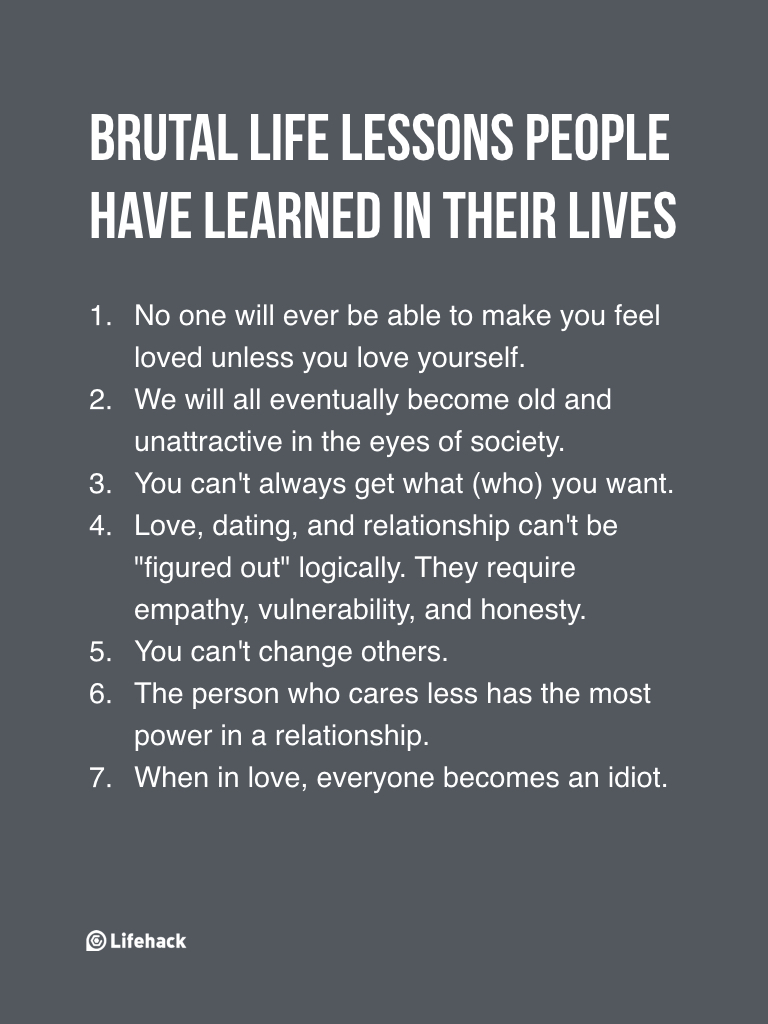
7 Brutal Life Lessons People Learned In Their Lives

screen-shot-2016-10-20-at-5-08-42-pm

dark-life-lessons-001

credit: Quora

The post 7 Brutal Life Lessons People Learned In Their Lives appeared first on Lifehack.

Lifehack

Lessons From Norway May Help Nudge American Dads Into Taking Paternity Leave

Paternity leave still hasn’t made it as a platform issue this election season, but, it's being increasingly brought into the spotlight.

News | Yahoo Health